



A website is not a storefront; it is a system of responsibility
For a long time, we accepted a convenient, almost innocent definition: the corporate website as a showcase. A simple word, apparently useful, with one deep flaw.
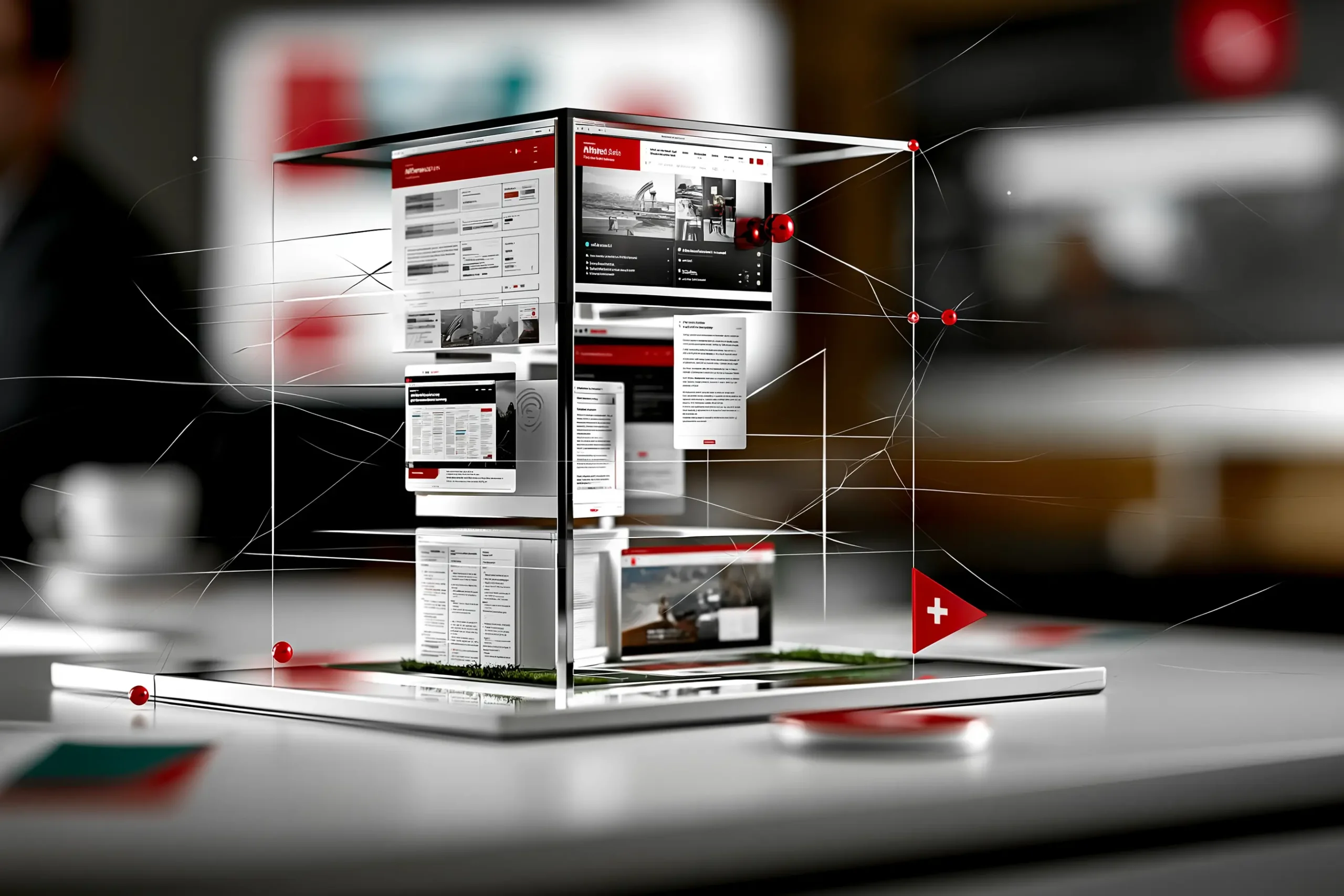
A website is not a showcase, it is a system of responsibility
For a long time, we accepted a convenient, almost innocent definition: the corporate website as a showcase. A simple word, apparently useful, with one deep flaw. A showcase displays, but it does not explain. It shows, but it does not govern. It may seduce, at best, but it rarely helps anyone understand how an organisation thinks, works, decides and takes responsibility for its choices.
The new Innovando Swiss website comes precisely from this awareness. Not as an aesthetic exercise, not as an ornamental restyling, not as a container in which to pile up pages, services, keywords and decorative images. It was conceived as an attempt to bring order to an ecosystem that has grown over the years, become more articulated, and produced tools, content, platforms, editorial experiences, technical environments and operational touchpoints.
When a company truly grows, the issue is no longer just saying who it is. The issue becomes more delicate: preventing its different parts from starting to speak different languages.
A corporate website, then, cannot simply aim to look good. It must become a place of governance. It must help those who enter understand what the company does, but also why it works in that particular way, according to which criteria, through which tools, and with what idea of responsibility. Without this depth, communication easily becomes scenery: well-designed pages, polished sentences, orderly promises, but little verifiable substance.
Innovando Swiss chooses to stand elsewhere.
Not because it rejects aesthetics. That would be absurd. Form matters, deeply. It matters because it guides, makes things readable, builds trust and gives rhythm to perception. But mature form does not conceal emptiness. It organises it, measures it, puts it to the test. A good interface should not make complexity disappear: it should make it navigable.
From website to structure
The new Innovando ecosystem is built on a simple but decisive distinction: not everything has to live in the same place. Everything, however, must belong to the same design.
Innovando Swiss is the corporate centre. It tells the story of identity, method, services, people, compliance, assessments, tools and relationship paths. It must not become a total archive, an endless brochure, a repository where every project demands space until navigation becomes tiring. The corporate website must remain clear. It must point the way, not occupy the entire landscape.
Around this centre, other presences operate. Innovando News brings the editorial and reputational dimension. Innovando Info safeguards the methodological and cultural layer. Innovando Tech explains the technological component. Innovando Cloud oversees infrastructure, hosting, continuity and security. Hotro organises support and technical relationships. Innovando Insight works on the semantic, editorial and technical quality of digital content.
These environments are not random satellites. They are functions. They make sense only if they remain connected, recognisable and coherent. An ecosystem is not created by multiplying domains, but by assigning each presence a precise role. Without this discipline, even the most ambitious project becomes noise.
The real challenge today is not having a website. Everyone has one. The challenge is building a digital system that does not contradict itself at every click.
Method, tools and continuity
In contemporary digital work, there is a recurring temptation: confusing speed with maturity. Publishing more pages, opening more channels, producing more content, installing more tools, automating more processes. Everything looks like movement. Not everything, however, is progress.
Sometimes digital growth produces nothing more than a more elegant form of disorder.
This is why Innovando has chosen to give increasing weight to method. Not as a presentation word, but as a concrete infrastructure. A method is useful if it reduces ambiguity, clarifies priorities, and makes it possible to distinguish an aesthetic problem from a structural one, a perception from a data point, a real urgency from a poorly formulated habit.
This is where tools come in. Not as gadgets, not as technological vanity, not as a show of strength. They come in to make the work more legible. A Strategic Brand Profile helps understand identity before it becomes communication. A Web Audit observes the website as an organism, not as a surface. A framework inspired by ISO logic introduces criteria, checks and responsibility. Innovando Insight makes it possible to read content, metadata, images, SEO, GEO and editorial consistency within a more controllable system. Hotro helps prevent support from dispersing after publication.
These elements have value only if they do not become fetishes. The best tool does not decide for us. It forces us to see more clearly before choosing.
The responsibility of content
A website speaks even when it is silent. It speaks through what it shows, but also through what it omits. It speaks through its titles, its images, its paths, its legal pages, the quality of its metadata, the clarity of its promises, and the way it manages privacy, consent, accessibility, security, updates and support.
For this reason, digital responsibility does not concern only the technical department. It is not an item to leave at the end of the project, once the design has already been approved and the texts have already been published. It concerns the very form of corporate presence.
A confusing page is not just a poorly written page. It is a responsibility left unassumed. A service described in generic terms is not just a missed marketing opportunity. It is a sign of strategic weakness. Compliance treated as a bureaucratic nuisance is not just a legal problem. It is a cultural fracture.
The new Innovando Swiss website was also created to make this conviction visible: communication is not a coating placed over the organisation. It is one of the ways in which the organisation becomes readable.
Less noise, more governance
There is another choice, perhaps less conspicuous but highly important: removing. Removing what disturbs, what weighs things down, what turns every page into a corridor full of prompts, buttons, banners, forms, related blocks and redundant invitations.
Not everything that can be added creates value. Often, it consumes it.
A mature website should not try to hold the user at any cost. It should respect their attention. It should accompany them with clarity, not chase them with anxiety. In this sense, sobriety is not visual poverty. It is discipline. It is the ability to distinguish between what is useful and what merely fills space.
This also applies to articles. Serious content needs space. It needs to breathe. It must be readable without being constantly interrupted by accessory elements. A table of contents, when useful, provides orientation. Social sharing, when discreet, makes things easier. Everything else must be assessed with rigour.
Cleanliness, simplicity and speed are not technical details. They are forms of respect.
An ecosystem, not a sum
Innovando Swiss is therefore a threshold. From here, one enters a broader ecosystem, but is not overwhelmed by the whole ecosystem at once. The design becomes understandable, its main parts are encountered, the method is discovered, and the paths for going deeper become clear.
This balance is delicate. A website that is too thin does not say enough. A website that is too full leaves nothing truly understandable. Between absence and saturation lies the most difficult space: the space of structure.
The work carried out on Innovando Swiss moves in this direction. It does not claim to be definitive, because no living ecosystem ever is. But it attempts to establish a grammar: clear identity, readable services, recognisable tools, compliance treated seriously, coherent editorial content, orderly external platforms and governable technical support.
A website like this is not merely an online presence. It is a statement of method.
It does not simply say: we are here.
It says something more demanding:
this is how we intend to work, decide, communicate and take responsibility for our choices.
INSTITUTIONAL NEWSLETTER

Swiss consulting company for digital strategy and communication. Assessment-based approach, focused on methods and oriented towards institutions.
Innovando GmbH
- Loretto, 4
- 9108 Gonten
- Appenzell Innerrhoden
- Switzerland
TAX DETAILS
- Commercial register: Appenzell Innerrhoden
- Registration date: 02/03/2013
- Registration nr.: 1138488
- VAT number: CHE-396.086,464
- Share capital: CHF 20,000
- DUNS Number: 48-692-9891
QUICK CONTACTS
OFFICE HOURS
- Monday
- 09:30-12:30 · 14:30-18:00
- Tuesday
- 09:30-12:30 · 14:30-18:00
- Wednesday
- 09:30-12:30 · 14:30-18:00
- Thursday
- 09:30-12:30 · 14:30-18:00
- Friday
- 09:30-12:30
- Saturday
- Closed
- Sunday
- Closed


